Archives for posts with tag: Stay-at-home dad

I’m not keen on vaccines for everyone. In America,we should be allowed to choose whether or not we wish to vaccinate ourselves and our children. All too often, and becoming more common, is the requirement for workers in the health care field to get vaccinated. For children, some schools won’t allow attendance until vaccine requirements are met.

I personally believe that vaccine manufacturers are controlling the FDA and the government in forcing us to vaccinate our children.

I’ve got nothing against vaccines. I take issue with the extreme sensationalism behind vaccinations. Lastly, it should be up to the parents to make the decision of vaccinating their own kids, not the government or businesses.

With that said, you now know my personal stance on vaccination.
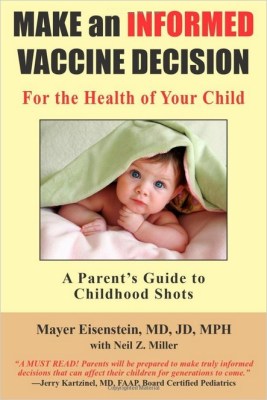
Make an Informed Vaccine Decision By Mayer Eisenstein

Make an Informed Vaccine Decision By Mayer Eisenstein, is a great read for parents who are concerned about vaccinations and their (ab)use in America. Eisenstein makes some really good points throughout, and follows up with evidence and clinical research data.  The reader can find both the pros and cons of vaccination.  Interestingly, Eisenstein puts forth some research data pertaining to illnesses and side effects possibly caused by vaccines.

The common vaccines are covered in this book: Polio, Influenza, Tetanus, Diphtheria, Pertussis, Measles, Mumps, Rubella, Chickenpox, Hepatitis A & B, Haemophilus Influenza Type B, Pneumococcal, Meningococcal, Rotavirus, Human Papilloma Virus.

This book also has a few sections pertaining to vaccines that have been heavily discussed: childhood autism, aluminum, other ingredients, and social obligation.

Eisenstein presents his feelings toward childhood vaccines right off the bat. His views and background are contained in the introduction. There is no guessing as to where he stands. The material presented on the various vaccines is concise with much of it seemingly unbiased. For someone like me, I like to be given plenty of information so that I can choose what to believe. The references provided at the end of each chapter allowed me to dig deeper into the material, if desired.

For example, the chapter on tetanus contains a brief history of tetanus, incubation period, and recent statistical data. The history of the tetanus vaccine, various combinations of tetanus drugs, and the safety of the administered drug is discussed. Then, the possible links between tetanus vaccine and diseases such as arthritis, neurological disorder, and immune system related diseases are included. Moreover, the efficacy data and VAERS (vaccine adverse effects reporting system) information is presented. Finally, Dr. Eisenstein leaves the reader with a list of references that assisted him in compilation of the chapter.  As you will see, there is plenty of material in each of the vaccine chapters for one to consider.

Another chapter, autism, talks about a possible correlation between MMR and autistic behavior. As well, there is mention of high levels of mercury being used as preservatives for vaccines. This chapter also lends itself to the idea that if significant correlation was made between autism and vaccines, there would be extreme legal action taken towards the pharmaceutical industry and CDC in America. There is a lot to digest and think about in this chapter, which makes it invaluable as a tool for making an informed decision about vaccination.

The book is well written overall and I can go on describing each chapter’s contents here. But I won’t. If you are looking for a book that gives you multiple perspectives about vaccination and the studies and secrecy behind it, then you will find the book’s information thought-provoking. And that is precisely what Eisenstein wants. He wants you to understand that not everyone is looking out for your baby’s interests. Pharmaceutical companies are powerful, profit-driven entities that control the vaccine industry. An informed consumer can keep safety research and clinical studies on the cutting edge by educating themselves.  It is up to the reader to protect themselves and make an informed vaccine decision for the health of his or her child.  This book is perfect for helping one do so.

—–

Overall Rating:  8 Worms

Readability:  8 Worms

Usefulness:  8 Worms

Manliness:  9 Worms  (Seems like it’s a man’s job to know about viruses, eh?)

Retail Price:  $14.95

—–

Pros:

Lots of good information on viruses and vaccines.  Plenty of references at the end of each chapter.

Cons:

The layout of the book could be a little more user friendly.

Things I would modify:

I would like to see more data included in the book rather than the reader being pointed towards the reference section.
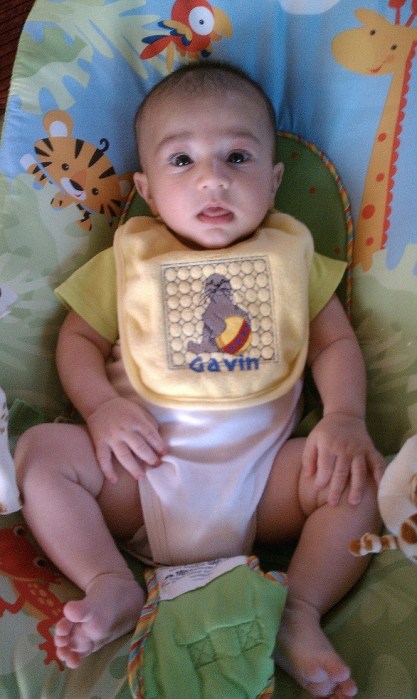
Gavin’s two and a half months old in this picture and I guess the flash surprised him!  One day, he’s going to discover this blog about him.  And that will really surprise him!

You Lookin' at Me?

With crawling comes exploration.  Our little Christopher Columbus is curious about everything in the house.  The fact that he can motor his little body towards just about anything he wants is a little unnerving…to us.  To him, it’s freedom.

I understand the saying now about how “curiosity kills the cat”.  Since Gavin’s curiosity has taken control, it has put him in some pretty precarious situations (that my keen agility and deftness, I might add, have rescued him from again and again).  I worry about him falling off of stuff and getting hurt.  I worry about him falling onto stuff and getting hurt.  I worry about stuff falling on him and getting hurt (him, not the stuff).

Now, I have one more worry.  Gavin eating stuff and getting hurt.  It’s a whole other level of harmful stuff.

Worm puts everything in his mouth.  I could show him a pile of dirt with sprinkles on top and he would probably eat it.  (In fact, during a kiddie play date last month, we caught him impressing the ladies with his dirt eating machismo.)  It doesn’t matter how disgusting it is, the object of interest must visit his drool cave and stay a while for Worm to befriend or condemn it.  It’s the gateway to his brain.  (I know I’m dating myself here, but do you remember in the movie Short Circuit where Johnny 5 keeps obsessing about “Input!  Input!  Input!”?  It’s how Johnny 5 learns about his environment.  Worm is doing the same thing, but with his mouth!)

And it’s my job to keep things like rat poison, toilet bowl cleaner, and bleach away from his pie hole.  Recently, I’ve added dead bugs to the list.

We don’t see many bugs in San Diego.  But, I’d venture to guess that most of the bugs in San Diego come to die either inside my house or on my back patio.  (We don’t advertise as an insect mortuary, but we’ll take care of your insect’s funeral humanely and discreetly for a small fee.  White glove service extra.)  The most recent string of obituaries are these lovely millipede looking things.

Does Anyone Know What These Are?

And some of those bugs that didn’t quite die on my property have given their lives to Worm’s stomach.  I don’t know what these bugs are, but one thing is for certain, they’re not gummy worms.  Well, they can’t be LESS healthy than sugar, yellow #5, and gelatin.  Maybe I’ll be proud that my baby loves this fresh, 100% organic and natural low-calorie treat.  (Very Californian, eh?)

You can now say that you are what you eat, right Worm? (Hold on a sec while I go vomit…)

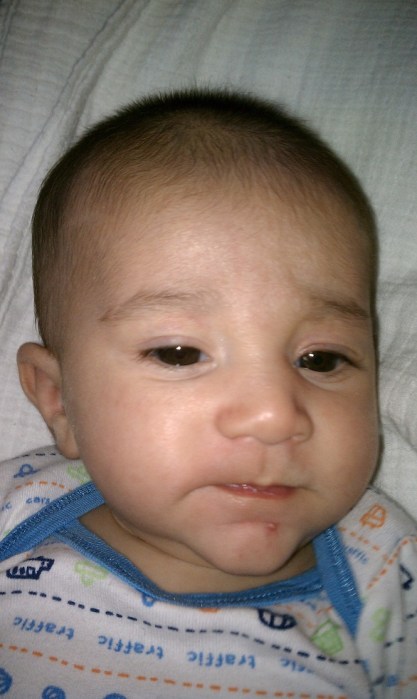
Puberty and hormones attack Gavin’s chin!

I'm So Distraught About My First Zit!

There are age recommendations for toys.  But why bother?  Either you can play with it, or you can’t.  So, I just toss the recommendations out the window…Well, I used to.

The toy that taught me and Worm a valuable life lesson is Jenga.  It’s mainly a game played (while inebriated) at an event where there’s more casual acquaintances and unknowns rather than friends.  It’s a nice ice breaker type of game.  Since Worm is lacking the traditional social skills of humans (verbal communication, nonverbal communication, emotional control, etc.), we decide that playing Jenga is a major socialization tool to increase his collection of friends at future milk and chicken pox parties.

Mattel states that Jenga is a game for “Ages 6 to adult”.  Personally, I didn’t realize that playing with blocks was conceptually advanced for a baby’s brain to wrap around.  But hey, this is America, where no child is left behind and the bar is set really low for educational pursuits so every child feels good about him or herself because that’s what’s really important in the world, not competition nor the drive to try to be the best you can be.  I digress.

I don’t know how many versions of Jenga are out there, but I’m assuming (which only makes an ass out of U and Ming, poor girl) that every Jenga has the same blocks that get stacked up and removed individually, with the reward of forcing a player to chug a beer or take a shot if one can keep the stack from crumbling to the ground.  When the Worm was presented with his new Jenga game, we allowed him to first try to get the container open.  And this is where I started to reevaluate that “Ages 6 to adult” idea.

Jenga is Dangerous For Children Under 6.

I’m impressed with his enthusiasm for the Jenga container.  But, this time enthusiasm gets the better of Worm.

I Was Appalled at the Animosity Jenga Had Towards My Innocent Child.

At Least He Got One Piece Out of the Container...

So, Jenga has set my son back mentally and emotionally.  He now wets himself, spits up, and cries.  Ok, so he was doing that before, but it seems like more liquid comes out of him now.  I blame it on the Jenga.  Worm will carry the scars of Jenga for the rest of his life all because we didn’t read the label.  Just a word of advice for parents.  Adhere to the age guidelines for toys!

Since I have nothing better to do I may have to start an organization that lobbies for pictures on the labels of toy packages showing the gory images of what happens when parents don’t adhere to the age recommendations (kind of like what the government wants to do with cigarettes).  I don’t want something like this to happen to any other child.  EVER!  Join me in my fight against parents having to read labels!

I have to give myself a point here because unlike Worm, I know how to open the Jenga container.  Besides, he’s still reeling from the trauma of the toy…I’m going to take advantage of him while he’s down!

Gavin – 8; Dad – 5

My kid has ugly toes.  (They’re not long, shapely, and seductive like my toes.)  He’s got short, stubby little sausages glued to the end of his foot.  His toenails are something alien, too.  You know how chefs will thumb press a raisin or a cherry into the top of the cookie dough clumps before baking the cookies?  Well, it looks like before our bun came out of the proverbial oven, the “Chef” hastily pressed ten toenails into Gavin’s chubby digits…and pressed a bit too hard.

Worm’s toenails are buried under his skin, which means nail clipping is never easy.  Since no parent wants to inflict visible pain on their children, nail clipping time becomes more than a game of hide and seek.  It’s a medical procedure with sharp metal objects, no anesthesia, and high stakes.  One wrong move and I maim my baby, thus rendering him the laughing-stock at the schoolyard.

“Looky over there!  Gimpy Gavin goes.

He’s got 8 fingers and only 7 toes.

His dad cut them off, and put them in a stew.

If you can’t run fast, he will do the same to you!

Picture Worm flailing all 4 limbs, screaming, crying and arching his back…simultaneously.  Then picture me with a firm grasp on the toenail to be trimmed…and nothing else.  “Well, is it skin or is it part of the nail?  I don’t know.  It’s so small that I can’t really tell.  Why are his nails the same exact color as his toes?  Is that normal?  Should I wait until later for Steph’s help?”  A screaming baby can drain the patience from any man.  “What the hell.  He’s already crying.  If I draw blood, then at least he’ll have a real reason to cry.”  Snip.

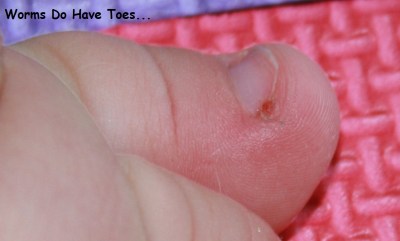
With nails and toes like his, it was only a matter of time before a nail volunteered for onychocryptosis duty.  For Gavin, it happened last night.

Tis' Only a Flesh Wound!

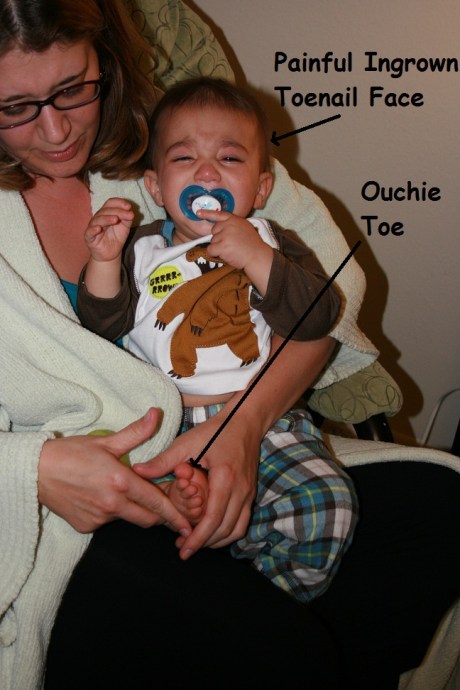
Ingrown Toenail? No Problem! Mom to the Rescue!

We’re lucky we caught it early.  For those that are hoping to share in this wonderful experience (It’s great fun, especially after midnight!), here are a few tips that I found useful:

  1. To prevent ingrown toenails from happening, clip your baby’s nails often.  I usually know it’s time to clip Gavin’s nails when he can grabs at my neck and some skin comes off.  (Remember that sometimes clipping the nails too short can be a problem.)
  2. If this has already happened to you, then don’t tell your friends.  They will know that you are too busy Facebooking to pay much attention to your baby.  You may be ridiculed and scoffed at.  Some parents may even report you for neglect and child abuse.
  3. Squeeze the toe to see if baby cries.  This is a pretty good sign of ingrown toenail pain.  Usually the offending toe will be red and may possibly ooze pus.  If you are upset that your baby woke you up in the middle of the night, squeeze the toe multiple times.
  4. Onesies with footies and socks can irritate the offending toe and can contribute to infection.  Allow the toe to breathe.  (It’s a saying.  Toes don’t really breathe.)
  5. Clip the nail as close to the skin as possible.  If you clip some skin also, don’t worry.  Your baby shouldn’t remember the pain you caused them with your early parenting mistakes.
  6. Soak the baby’s foot in warm water for 5-10 minutes, a couple of times a day to loosen up the skin and encourage healing.
  7. Apply anti-bacterial ointment.  Just keep baby from eating it.
  8. If necessary, you can give your child acetaminophen for the pain.  It may help get both you and the baby some much needed sleep.

For my unpreparedness, Worm gets a point.  You keep testing my skills eh, son?

Gavin – 8; Dad – 4

y'all - the magazine of southern people

y'all - the magazine of southern people (Photo credit: lacylouwho)

I was reading an article today about vocabulary terms kids should know by the time he/she hits the two year old mark.  Researchers use the two year mark as a starting point for the testing of developmental disorders, such as deafness, autism, dyslexia, etc.  Children at or near this age should understand words such as:  hi, bye, mommy, daddy, cat, dog, and so on (you can see the rest of the list through the link at the bottom).  If not, it could mean that your child could have some mental development issues or could just be your child is prepping for a life of professional athletic prowess.

I agree that some of the words from the list are important for a normal baby to recognize, but I spent a lot of my youth in the south where the language is, um, a bit different.  There is no way for southerners to compare their kids to the list presented by the Child Study Institute at Bryn Mawr College.  Therefore, I’ve made a list to handle the largest portion of non-English speaking Americans.  This is the first list of 25 words/terms that your 2-year-old country bumpkin should know.

So, I’ve compiled a list of the 25 words your budding redneck boy or gal should know along with a brief definition or english translation.  If your son or daughter cannot repeat/understand any of the words below, take the whiskey bottle away from your child for a few hours and try again.

  1. Maw – equivalent to mother.
  2. Paw – equivalent to father.
  3. Mamaw – equivalent to grandmother.
  4. Pappee – equivalent to grandfather.
  5. Bubba – term for brother.  Sometimes used as a term for any male.
  6. Sissy – term for sister.
  7. Cuddins – relatives.  Example:  It’s aright for cuddins to kiss.
  8. Yall – means you all.  Also, commonly used to refer to one person.
  9. Yous – the plural form of you.  More strongly directed form of Yall.
  10. Arraz – equivalent to ours.  Emphasis is on the 1st syllable.  Example:  When we marry arraz cuddins, we stay kin.
  11. Dem – equivalent to them or those.  Example:  Dem critters is still food.  Just wash dem up and toss dem in da oven.
  12. Warsh – to clean.  Example:  We warsh the baby same time as the dawg, once a month!
  13. Ignant – equivalent to ignorant.  Example:  Don’t be ignant!  Wrasslin is real!
  14. Sodeepop – carbonated beverage, such as Pepsi, Coke,or Cactus Juice
  15. Skeeter – equivalent to mosquito.  Example:  These dang skeeters is bitin’ me all up on my nayk.
  16. Aye-rab – any person of color.  Example:  Amerka has its first aye-rab prezdent, Obama.
  17. Larnin – education.  Example:  We gots to get sum larnin if we gonna geet jobs.
  18. Vittles – food.  Example:  Boy! Stop tossin’ them vittles at the dawg and eat’em up yur sef.
  19. Coon – equivalent to racoon.  Example:  We dun cawt us two coons for suppa!
  20. Raffle – gun or firearm.  Example:  I see coons!  Quick, gimme dat raffle!
  21. Fixin – term for “going to” or “getting ready to”.  Example:  I’m fixin to whoop dat skweelin baby!
  22. Treller – home or house.  Example:  My maw and paw live in separate trellers, but least dem’s in the same treller park!
  23. Winna – equivalent to window.  Example:  My camaro’s got natural a/c.  Just crack the winna and feel that cool air.
  24. RicinNASCAR.  Example:  Lemme git my lucky #3 hat on, cuz it’s car ricin weekend!
  25. Laff – equivalent to life.  Example:  The happiest 3 years of my laff wuz spent in 10th grade.
If you want to see what the original 25 words were, see here:
The 25 Words Every Toddler Needs To Know