Archives for category: Food

Here’s the skinny.  It’s Worm.

We had our 1 year checkup with the pediatrician.  She breaks out her measuring sticks to size up our future NBA all-star.  (We’re making him sleep with a couple of basketballs to get him dreaming about the game.  It’s called mental preparation.)  Then she punches the stats into her machine (sometimes called a computer) and out comes a chart.  It shows us that our baby is less than 30% in the weight category for his age.  (Hello?  Have you seen ‘dat baby’ daddy?)  Apparently, skinny babies are not in vogue.  We get lectured.

“What types of foods are you feeding him?”

“You know.  Formula, fruits, veggies, rice, quinoa, potatoes, chicken, etc.  We try to feed him healthy stuff.  Organic, if possible.”

The doctor’s brain hears the words “healthy” and “organic” and instantly translates our words to something more like “We are vegetarians and we only feed our kid grass-fed wheatgrass and imported kale chips.  And occasionally, granola.”

WTF?

We try to abate the doctor’s fears of our child abuse by letting her know that our child is extremely active.  When awake, he doesn’t stop crawling, playing, or moving.  The blank stare she returns lets me know her brain didn’t register a thing I said.  Then she starts in.

“You should be feeding him high calorie foods, like whole milk, butter, cheese, cream cheese, regular yogurt.  You know, things like that. No low-fat food.”

“Sounds great!  From what you’re saying, most of his calories should be from milk products.  We’re going to cut out the middle man and just buy a cow for Worm.  (That’s what Indians do, right?)  It’s probably the best way to get him fat enough to be ‘in the 50th percentile’.  There doesn’t seem to be any downside to loading up on dairy!”  (Ok, I didn’t say that to her, I just nodded and smiled.)

In my brain, I translate the rest of her ‘blah, blah, blah…’ to “Listen you damn new age hippies.  The fact that you even question vaccines for your baby means that you’re crazier than Mel Gibson.  Can’t you see that you’re the problem with society?  If you don’t feed your baby tons of cow products, then we can’t sustain the beef and milk industry, the pharmaceutical industry (bovine antibiotics and hormones) will go out of business, the price of beef will skyrocket, and I’ll never see a 99 cent cheeseburger again.  So stop smoking the weed, sniffing the tie-dye, and dancing naked during the full moons.  Get your kid fattened up or else….

And to make sure he puts on weight, I’m scheduling a weigh-in for Gavin in 6 weeks.”

To Be Continued…

What About the Milk Chocolate, Dad?

After posting a recent article on a little girl genius, I’d like to give you a taste of what the dunderhead (IQ = mine) part of the population does to make more rational people shake their heads in disbelief.

We’ve started feeding the Worm solid foods about 6 months ago.  He’s got an insatiable appetite for all things edible (or plastic).  At around the 10-month old mark, we started allowing Worm to feed off our dinner plates.  He would point at what looked appetizing and we would let him sample it.  Vegetables, rice, chicken, pasta, etc.  Of course, only foods that were shown to be low on the food allergy list were dropped into the baby’s mouth.  It was fun to see what Worm liked and didn’t like to eat.

Then one day, we decided to get a little crazy with the food selection.

In the morning, we decided to make Worm a peanut butter and jelly sandwich.  (In case you were wondering, peanuts can be severe and life-threatening for those with a peanut allergy.)  We definitely wanted to test out peanut butter on the Worm.  This isn’t the dunderhead part.  We planned on giving Worm peanut butter that day, especially in the morning.  If there was a reaction, we would be awake and ready to drive him to the hospital emergency room.

Here’s dunderhead move #1.  The jelly part of the sandwich was a mixed berry blend and strawberries were one of the ingredients.  (Strawberry allergies are fairly common.  Did I know this ahead of time?  Yes.  Did I use my brain to make the PB and J sandwich? No.)  I probably should have used grape jelly instead.  (Did you know that white strawberries do not produce the allergic reactions of the red ones?  Read here. Did I just increase your IQ by one point?  I sure did.)

One of the rules of experimentation is that you don’t test two variables at the same time.  (All we could say was oops and thank god he didn’t have a reaction to either peanut butter or strawberries.)

Another rule of experimentation is that you must wait until the first experiment is complete before running another experiment.  Did we wait?  Not even a whole day passed before we shoved another couple of high allergy foods into Worm’s mouth!

For dinner that same night, Steph, Grandma, and I went to our neighborhood Chinese food buffet.  (It makes total sense to take a baby to a buffet once he starts to eat solid foods, right?  I mean, why open the door a little bit?  Why not throw the door wide open and break it off the hinges?)

Hey?! Where's the cupcakes and cheezy poofs?

In what could be called overzealous enthusiasm (or reckless stupidity), we decided to feed Worm a variety of foods from the buffet trays.  And we didn’t realize that some of the foods had shrimp, fish and/or fish products in them until after Worm had eaten.  (Fish and shellfish are also very high on the food allergy scale.  Severe reaction such as anaphylaxis or anaphylactic shock can occur upon eating.)  Did I think about this ahead of time?  No.  Dunderhead move #2.

We got lucky that day.  Our family history only shows shellfish allergy from one of the grandpas and no one else.  The chances of food allergic reaction in Worm was pretty low.  But, we will try to be a little bit smarter in dealing with any more of our kids in the future.

If there is anything that you can learn from an idiot like myself, it’s this:

  • Don’t do what I did.  Give your kids one potentially high allergy food every couple of days.  You should let your child pass the new food through their gastrointestinal system before moving on to another.
  • Check your family history of allergies.  Make note of who in your family has allergies to alert yourself of potentially reactive foods.  Food allergies can be passed down.
  • Make a list of the high allergy foods you want your baby to try (Cow’s Milk, Wheat, Soy, Peanuts, Tree nuts, Fish, Shellfish, Eggs are very highly allergic).  Check off the ones that your baby has tried and make note of any bowel movement changes.
  • Check your baby’s skin for any changes after eating.  (It’s hard to tell if your baby has a skin rash if you can’t see through onesies.)  Check again after each diaper change for any redness, hives, bumps, etc.
  • Read food labels.  (Unless you’re at a buffet and you’re trying out the free-for-all smorgasbord technique like we did.  Not recommended.)
  • Know where the hospital is.  Severe allergic reaction in babies can constrict airways pretty quickly.  Lack of oxygen can lead to brain damage. You don’t want to waste time seaching the internet for the hospital during an emergency.
Related Links:

Food Allergies in Babies

How To Test Foods on Your Baby For Allergies  (Very informative blog)

Peanut Allergies in Babies

Strawberry Allergy Signs in Babies

http://www.achooallergy.com/blog/strawberry-allergy-/

With crawling comes exploration.  Our little Christopher Columbus is curious about everything in the house.  The fact that he can motor his little body towards just about anything he wants is a little unnerving…to us.  To him, it’s freedom.

I understand the saying now about how “curiosity kills the cat”.  Since Gavin’s curiosity has taken control, it has put him in some pretty precarious situations (that my keen agility and deftness, I might add, have rescued him from again and again).  I worry about him falling off of stuff and getting hurt.  I worry about him falling onto stuff and getting hurt.  I worry about stuff falling on him and getting hurt (him, not the stuff).

Now, I have one more worry.  Gavin eating stuff and getting hurt.  It’s a whole other level of harmful stuff.

Worm puts everything in his mouth.  I could show him a pile of dirt with sprinkles on top and he would probably eat it.  (In fact, during a kiddie play date last month, we caught him impressing the ladies with his dirt eating machismo.)  It doesn’t matter how disgusting it is, the object of interest must visit his drool cave and stay a while for Worm to befriend or condemn it.  It’s the gateway to his brain.  (I know I’m dating myself here, but do you remember in the movie Short Circuit where Johnny 5 keeps obsessing about “Input!  Input!  Input!”?  It’s how Johnny 5 learns about his environment.  Worm is doing the same thing, but with his mouth!)

And it’s my job to keep things like rat poison, toilet bowl cleaner, and bleach away from his pie hole.  Recently, I’ve added dead bugs to the list.

We don’t see many bugs in San Diego.  But, I’d venture to guess that most of the bugs in San Diego come to die either inside my house or on my back patio.  (We don’t advertise as an insect mortuary, but we’ll take care of your insect’s funeral humanely and discreetly for a small fee.  White glove service extra.)  The most recent string of obituaries are these lovely millipede looking things.

Does Anyone Know What These Are?

And some of those bugs that didn’t quite die on my property have given their lives to Worm’s stomach.  I don’t know what these bugs are, but one thing is for certain, they’re not gummy worms.  Well, they can’t be LESS healthy than sugar, yellow #5, and gelatin.  Maybe I’ll be proud that my baby loves this fresh, 100% organic and natural low-calorie treat.  (Very Californian, eh?)

You can now say that you are what you eat, right Worm? (Hold on a sec while I go vomit…)

When it became time to work solid food into the Worm’s diet, I was pretty excited.  Introducing fruits and veggies has been a lot of fun.  Although he makes some pretty twisted faces during feeding time, he manages to swallow everything down without incident…unless, he sneezes.  Let’s knock on wood a little here, since Worm’s never completely turned down anything yet.  He’s pretty keen on food and will even occasionally munch on grass in the backyard.

When Gavin hit the 6 month mark, we gave real food the green light.  Bananas were the first to be sacrificed by the Kalorik Baby Gourmet food processor.  Then avocados, apples, etc.  At 7 months old, we got frisky with exotic fruit like mangos and papaya.  I don’t know why, but I was very interested in seeing if Worm liked these fruits.  Ok, I do know why.  These fruits grow in my mother country, Trinidad, and I must get Gavin to eat these and love them, dammit.  (He’s got West Indian blood in him!  And I want to know how much…)

I had to be present for the very first mango feeding.  Mango is my all-time favorite fruit.  So, this was like a paternity test for us.  I was so anxious, I had to empty my bladder before the big moment to avoid any incident.

There definitely was a sourpuss face with first bite of mango puree.  With bated breath, I wished for a more positive response on the second spoonful.  Gavin swished the mutilated mango morsel around for a second, then swallowed the mouthful down and opened his mouth for more (like one of those starving baby birds on the nature channel!)  Success!  (I patted him on the back with ” You really ARE my son!  There’s no need for us to get Maury Povich involved.”)  He figured out how delicious mangos were, and powered through the rest of the puree.

It looks like I’m going to have to learn to share the fruit of my labor with the fruit of Steph’s labor…or start hiding my mangos in the underwear drawer!

If you didn’t already know, there’s one mango that I’ve yet to try out….the Tebow mango!

I love mangos! Just like daddy!

Another Chef Steph creation.  This recipe is also full of antioxidants, vitamins and minerals!

Ingredients:

  • 2/3 cup baby carrots, chopped
  • 1 cup sliced peaches (I used the frozen ones, but if they are in season, fresh is even better)
  • 1/2 cup yam, chopped
  • 1/2 cup yellow summer squash, chopped (you can also use green summer squash or zucchini)

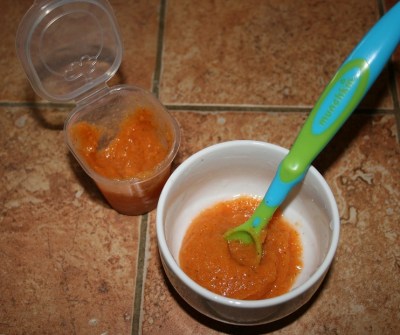
Orange You Glad I Didn't Say Carrot - Carrots, Peaches, Yams, and Squash

Preparation:

Place the carrots and yam in the colander over boiling water; cover
and steam for 10 minutes. Add the peaches and squash and steam for an
additional 10-15 minutes or until everything is thoroughly cooked and
soft. Place in a food processor along with some of the steaming liquid
and puree to desire consistency. This freezes well and keeps in the
fridge for 5-7 days.

So here is my next recipe for the wee one; it is full of antioxidants, vitamins, and is sure to create diaper surprises in all sorts of interesting colors (and sounds)!

Ingredients:

  • 1/2 cup frozen blueberries, defrosted
  • 3-4 small purple potatoes (our grocery happens to carry these, and they are the most gorgeous color you’ve ever seen on a vegetable – if you can’t find them, you can substitute with any small potato such as baby yukon or red bliss)
  • 1/2 cup cauliflower (I’ve actually seen a purple variety of cauliflower at the store before that would have been too cool for this recipe, but alas, they didn’t have any when I was shopping, so I used the regular kind)

Purple Explosion - Blueberries, Purple Potatoes, and Cauliflower

Preparation:

Peel and cut the potatoes into cubes.  Cut the cauliflower into small pieces. Place the potatoes and cauliflower in the colander over a pot of boiling water and cover, steaming for 10-15 minutes or until both can be smashed easily with a spoon. Add the blueberries and steam for an additional 3-5 minutes. Place everything as well as some of the steaming liquid into a food processor and puree to desired consistency. Potatoes don’t freeze so well, so this is best made in small batches as it will keep in the fridge for 5-7 days.

IMPORTANT NOTE: These recipes are for more advanced eaters. Your babe should be at least 9 Mo old, have been eating solids for a while, and ideally have had most, if not all of the components in the recipes previously to ensure there was no reaction. Once they hit 9 Mo and have had a wide variety of foods, it’s okay to introduce more than one new thing at a time, but be on the lookout for any signs of an issue such as rash, tummy ache, excessive gas or change in eating habits. Unless, of course, they all the sudden start wolfing down the food, and then you can just chock it up to my mad food-making skillz.

English: A honeycrisp apple from an organic fo...

Image via Wikipedia

We have all heard about the organic debate, right?  There’s a hefty premium on organic produce and the jury is still out on whether or not the non-organic produce grown is dangerous.  For me, I like to err on the side of caution and common sense.  The industrialization of food in America has brought more food to our tables at a lower cost.  Yes, that’s great.  But, I believe that the quality of the fruits and vegetables has spiraled downward.

I discovered what real organic farm grown fruits tasted like a few years back while Steph and I were on a road trip.  We happened to stop off at a fruit stand in the middle of nowhere California.  We parked next to the sign “Fresh Strawberries” and got out to take a look.  The strawberries were nowhere near the size that you typically see at the supermarket.  They weren’t perfect looking either.  Let’s just say that you can’t judge a book by its cover.  As I bit into the strawberry, I was blown away by the taste.  Wow, I had never in my life tasted a strawberry that flavorful before!

Industrialized farming and genetic modification of foods has to have a downside, right?  If you don’t believe this, then you’re kidding yourself.  Our American culture appeals to the idea that bigger is better and more is definitely better.  In order to yield more edible substance per acre of land, we’ve got to fertilize the soil.  Do you think that the perfect amount of fertilizer is used to grow plants?  Did you read the part I just wrote 3 sentences back?  The excess fertilizer ends up in our water source.  So, we’re drinking it.  (But, that’s for a different blog post.)  How else do you increase the yield of fruits and vegetables?  Kill the bugs that are eating our produce.  Enter pesticides.  Now here’s where the apples come in.

Non-organic apples (I won’t use the word conventional because that exemplifies that it is the normal standard.  What industrialized food does to everything around us is abnormally standard) are loaded with pesticides.  Why? Because growers are trying to kill 40 different types of insects, diseases, fungi, etc. that attack the bark, leaves, roots, and fruit of the apple tree.  There are other reasons for the high amount of pesticides in apples and that relates to the process of growing, harvesting, and storing.  But, it’s too much to go into here…and if you’re still reading this, you’ve got a great attention span!

So, what I’m saying is that many of us parents are giving our children apples to eat in different forms.  (Don’t forget about apple juice and apple sauce, and apple pie, and candy apples, and…)  Apple is a typical food that is introduced during the solid food stage.   Many of us introduce it early and use it often.  In our house, we are lucky enough to afford to purchase a few organic fruits and veggies (Thanks Steph for working hard!) and make sure that our baby is getting the best nutrition we can manage during his growing years.  (When he’s a college kid, I’m sure he’ll eat a boatload of chemically laden manufactured foods…but he will make that decision for himself.)


Don’t believe for a second that everyone else is looking out for your interest.  Being an informed consumer is always in you and your family’s best interest! (Is that even a sentence?  You know what I mean!)


Just one of the many articles talking about pesticides and produce.

http://www.cbc.ca/news/health/story/2011/06/14/apples-pesticides-fruits-vegetables.html

You can see how many pesticides are sprinkled into apples and some of the other foods we eat!  Yeah!

http://whatsonmyfood.org/food.jsp?food=AP

You can read about the USDA finding the greatest amount of pesticides in apples, celery, and strawberries.

http://www.consumeraffairs.com/news04/2011/06/bad-apples-usda-finds-pesticide-residues.html

These are the people that do some of the testing on our environment to make sure it’s safe for us to eat, sleep, and breathe.

http://www.ewg.org/