
Especially on me! Even though this pic was taken last summer, it feels like a decade ago.

Summertime Napping With Daddy!
Especially on me! Even though this pic was taken last summer, it feels like a decade ago.
Summertime Napping With Daddy!
Worm’s got an uncle in Florida. A nice uncle. An uncle that will bestow upon him all the latest gadgets and gizmos that his generation will fawn over. I have a strong feeling that this uncle (let’s call him Faldo to protect his innocence, if he’s got any left) will be the go to guy when Worm wants something and mean Mommy and unreasonable Daddy won’t buy it.
Uncle Faldo loves his nephew from afar, which means he expresses his affection mainly in gifts. At least for now, the Worm’s too young to understand where gifts come from. But when he realizes that uncle Faldo has the power of a year-round St. Nick and can be reached instantly via phone rather than snail mail, trouble (for Steph and I) will surely come. (I can just hear it now…”But Dad, all the cool kids at school got one! You suck! I want to go live with uncle Faldo!”)
Enter the first of Uncle Faldo’s generous presents…the VTech Alphabet Train. It’s so big, it may need a parking space in the garage.

Chicks Dig a Nice Set of Wheels!
I’m no child psychology expert, but don’t let that deter you from believing anything I say. Confining children helps them in later life. It lets them learn about boundaries and barriers. It teaches kids that the best way to encourage good behavior is to separate them from a negative environment. (Isn’t that what prison does? Positive space = jail. Negative space = world.)
Building barriers quells the human desire to see what is on the “other” side. For example, let’s suppose we have a barrier (in this case, a liquor cabinet) protecting the parents’ best rums (such as Zacapa, Anniversario, Orinoco, Gosling’s Black Seal). We know that keeping the liquor inside the cabinet insures that the child will lose their curiosity about the liquor cabinet and not invite their friends over when you’re not home and partake in the spirits and then refill the bottles back to the marked lines with water. It’s all because of the barrier between child and liquor. So, in that same frame of mind, we’ve got a baby cage barrier for Gavin!
He’s a curious little bugger and I am lazy can’t keep my eyes on him all the time. With all of his mobility and sleight of hand, he catches me off guard. And I’ve got to race over to wherever he is to save him from chewing up power cords, eating magazine covers, and throwing remote controls. Plus, there are things in the living room that can seriously hurt him…like unpausing my PS3 game controller and pushing the buttons. (Ok, that’s me hurting him. But, the end result is the same. Pain!)
To keep prying fingers out of electrical sockets, mouse traps and open bleach containers, we hope the baby jail will prove to be a formidable obstacle.
Check it out!
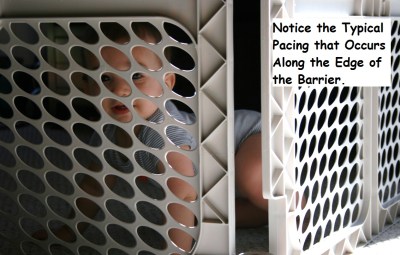
Caged Animal Behavior - Pacing

Caged Animal Behavior - Feeling Threatened

Caged Animal Behavior - Attack Mode
Giuliano Stroe is the strongest 5-year old boy in the world. He holds the world record for walking on his hands for 10 meters with a weight between his legs. Um, I can’t even walk on my hands for 10 inches before falling on my face. In the article, it says that Stroe’s been working out at the gym since he was born! (Boy, his dad really started him exercising early.) I believe it. I mean, Giuliano’s got a 6 pack that would make grown men cry…and he’s only been at it for 5 years!
Which brings me to review my lackadaisical attitude towards Gavin’s training. I’m already 11 months behind and his Buddha belly is more doughboy than washboard. Time for me to get to work. To make up for lost time, I added some extra weight to the barbell for him. If Stroe trains 2 hours a day, I’ll make let Worm train 3.
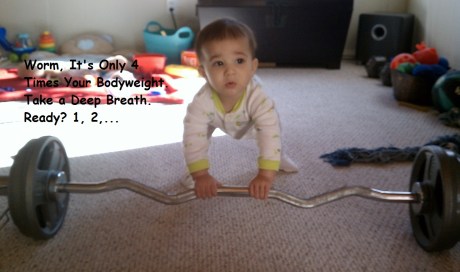
Dad, I Think I Strained Too Hard. Can You Check My Diaper?
You can see the current World’s Strongest 5-year old in the links below:
http://news.softpedia.com/news/5-Year-Old-Boy-Sets-New-Record-Becomes-World-s-Strongest-125417.shtml
But, it wasn’t as satisfying as I thought it would be. In fact, I was crushed too.
Worm has a way of telling us what he wants. He points (somewhat close to the object he wants) and says “Ah!” If it’s food, Worm’s mouth cranks wide open to help us translate the babble. And if we don’t tickle his fancy, the “Ah!” sound gets louder and more shrill. I’m not saying that we always give him what he wants, but if given a choice between a whining baby and a smiling baby, we seldom choose the former.
So, last night the Worm was eating some cheezy poofs (organic broccoli and cheese, of course) in his high chair. The poofs were spread around his eating table in orderly baby fashion. Since I love playing around with Worm, I decided to give him the “sign” that I wanted a cheezy poof. I pointed at the poof and went “Ah!” and I opened my mouth so he could feed me. Thinking that he would understand my baby lingo, I waited for my boca grande to enter supreme cheezy poofiness. Nothing.
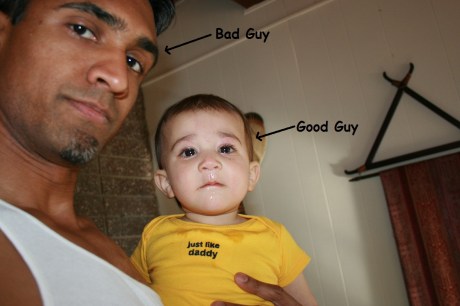
I'm Never Wearing This Shirt Again! Where's My "Just Like Mommy" Shirt?
Then I see Worm look at me as he’s never looked at me before, frightened. He leaned away from me in his chair, turned his head, and was frozen still. He didn’t move for about 15 seconds and I watched his little brown eyes turn red and well up with tears. His little mouth turned down and was trembling. Then he started sobbing. Not like the “I want that Tickle Me Elmo Doll now!” sobbing. It was the classic “My best friend in the whole world is moving away to Alaska and he’ll never survive there as a vegetarian!” kind of sobbing.
I spent the rest of the evening trying to make up with him, chasing him around the room, tickling him and looking for some interaction. But, I got nothing. I couldn’t explain to him that maybe my “Ah!” didn’t come out right. I should have said “Ah!” instead of “Ah!” Even if he could understand, he wouldn’t hear it.
He didn’t make eye contact with me again that evening.
I’ve got to do the adult thing to get back on his good side. I’ll have to buy him a bike.
I’m good at being pathetic. No, I’m great at being pathetic. I have a natural ability to connive persuade others to come rescue me from myself. (I like to call my gift of persuasion, charisma.) This time, the victim hero to come to my aid is none other than my mom!
It only took a couple months of daddyblogging here on MVG and a few heartwarming Gavin videos to get mom on a plane to help parent the new parents. (Isn’t the internet great!) I sounded desperate enough to get grandma to stay for a jaw-dropping seven weeks. Hooray for grandmas!
So, I’m thinking with the extra set of hands, Steph and I will get to rejuvenate ourselves both physically and mentally. I’ll get to dust off my bike and ride again after 2 years hiatus. I’ll get to exercise by doing something other than crawling around on all fours chasing the baby. I’ll get to eat my breakfast and lunch like a normal human…you know, by chewing! Steph and I will rekindle our relationship with long walks on the beach, candlelight dinners for two (not two and a half), and watching romantic movies together while kissing during the mushy parts. We will go for long, scenic drives in the mountains and through the desert (without having to feed, change, and/or calm a whining baby in the back seat). In short, we will return to our lives BB, before baby, if only briefly!

Grandma is Here to Save the Day!
It’s not like we’ll leave grandma holding the baby and the diaper bag. She’s a pro and this is old hat for her. She raised two unruly boys into semi-functional adults. I know it was before electricity and light bulbs, but some childrearing tricks don’t change. And if anyone’s got baby tricks, it’s my mom. In fact, she will probably fix all the mistakes I’ve made with Gavin in one week and have him taking out trash and vacuuming by the end of her stay with us. (Isn’t that great? And all we have to do for grandma is feed and water her!)
So, blue skies, romance, and Stephanie, here I come! My mom is here to give us reprieve and tame the wiggly Worm!
I’m not keen on vaccines for everyone. In America,we should be allowed to choose whether or not we wish to vaccinate ourselves and our children. All too often, and becoming more common, is the requirement for workers in the health care field to get vaccinated. For children, some schools won’t allow attendance until vaccine requirements are met.
I personally believe that vaccine manufacturers are controlling the FDA and the government in forcing us to vaccinate our children.
I’ve got nothing against vaccines. I take issue with the extreme sensationalism behind vaccinations. Lastly, it should be up to the parents to make the decision of vaccinating their own kids, not the government or businesses.
With that said, you now know my personal stance on vaccination.
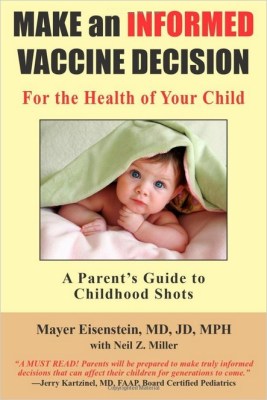
Make an Informed Vaccine Decision By Mayer Eisenstein
Make an Informed Vaccine Decision By Mayer Eisenstein, is a great read for parents who are concerned about vaccinations and their (ab)use in America. Eisenstein makes some really good points throughout, and follows up with evidence and clinical research data. The reader can find both the pros and cons of vaccination. Interestingly, Eisenstein puts forth some research data pertaining to illnesses and side effects possibly caused by vaccines.
The common vaccines are covered in this book: Polio, Influenza, Tetanus, Diphtheria, Pertussis, Measles, Mumps, Rubella, Chickenpox, Hepatitis A & B, Haemophilus Influenza Type B, Pneumococcal, Meningococcal, Rotavirus, Human Papilloma Virus.
This book also has a few sections pertaining to vaccines that have been heavily discussed: childhood autism, aluminum, other ingredients, and social obligation.
Eisenstein presents his feelings toward childhood vaccines right off the bat. His views and background are contained in the introduction. There is no guessing as to where he stands. The material presented on the various vaccines is concise with much of it seemingly unbiased. For someone like me, I like to be given plenty of information so that I can choose what to believe. The references provided at the end of each chapter allowed me to dig deeper into the material, if desired.
For example, the chapter on tetanus contains a brief history of tetanus, incubation period, and recent statistical data. The history of the tetanus vaccine, various combinations of tetanus drugs, and the safety of the administered drug is discussed. Then, the possible links between tetanus vaccine and diseases such as arthritis, neurological disorder, and immune system related diseases are included. Moreover, the efficacy data and VAERS (vaccine adverse effects reporting system) information is presented. Finally, Dr. Eisenstein leaves the reader with a list of references that assisted him in compilation of the chapter. As you will see, there is plenty of material in each of the vaccine chapters for one to consider.
Another chapter, autism, talks about a possible correlation between MMR and autistic behavior. As well, there is mention of high levels of mercury being used as preservatives for vaccines. This chapter also lends itself to the idea that if significant correlation was made between autism and vaccines, there would be extreme legal action taken towards the pharmaceutical industry and CDC in America. There is a lot to digest and think about in this chapter, which makes it invaluable as a tool for making an informed decision about vaccination.
The book is well written overall and I can go on describing each chapter’s contents here. But I won’t. If you are looking for a book that gives you multiple perspectives about vaccination and the studies and secrecy behind it, then you will find the book’s information thought-provoking. And that is precisely what Eisenstein wants. He wants you to understand that not everyone is looking out for your baby’s interests. Pharmaceutical companies are powerful, profit-driven entities that control the vaccine industry. An informed consumer can keep safety research and clinical studies on the cutting edge by educating themselves. It is up to the reader to protect themselves and make an informed vaccine decision for the health of his or her child. This book is perfect for helping one do so.
—–

Overall Rating: 8 Worms
Readability: 8 Worms
Usefulness: 8 Worms
Manliness: 9 Worms (Seems like it’s a man’s job to know about viruses, eh?)
Retail Price: $14.95
—–
Pros:
Lots of good information on viruses and vaccines. Plenty of references at the end of each chapter.
Cons:
The layout of the book could be a little more user friendly.
Things I would modify:
I would like to see more data included in the book rather than the reader being pointed towards the reference section.

 Me vs. Gavin